
Haoyu Gu

Hi, I'm Haoyu Gu!

Undergraduate Student in Artificial Intelligence

I'm passionate about Music Representation and Generation, Affective Computing, and Brain-Computer Interface. Let's build something interesting together! 🚀

📞 +86 18100607076 (WeChat: same number) | 📧 ghy20050104@gmail.com

📍 Nanjing, Jiangsu, China | Last Update: April 19, 2026

About Me

Current Status

I'm a junior undergraduate student majoring in Artificial Intelligence at the School of Future Technology, South China University of Technology (SCUT).

Location

Based in Nanjing, Jiangsu Province. School located in Guangzhou, Guangdong Province.

Education

Jan. 2024 – Present

South China University of Technology

985 Project University, Excellence 9 (E9) League Member

未来技术学院 - One of China's first 12 Future Technology Schools

Major: Artificial Intelligence

Academic Performance: GPA 3.95+

Core Courses: C++ Programming, Python Programming, Discrete Mathematics, Data Structures, Computer Networks, Computer Organization and Architecture, Database Systems, Circuit Analysis and Analog Circuits, Digital Circuits, Signals and Systems, Digital Signal Processing, Machine Learning, Deep Learning and Computer Vision

Sep. 2023 – Dec. 2023

South China University of Technology

吴贤铭智能工程学院

Major: Robotics Engineering

Sep. 2020 – Jun. 2023

Nanjing Ninghai High School

Sep. 2017 – Jul. 2020

High School Affiliated to Nanjing Normal University, Shuren School

Sep. 2011 – Jul. 2017

Nanjing Langya Road Primary School

Honors & Awards

Jun. 2025

Future Technology Taihu Innovation Award

学业创新一等奖

无锡市政府

May 2025

Lanqiao Cup C++ Programming Contest (Group A)

广东省二等奖

工业和信息化部人才交流中心

Nov. 2024

China Mathematics Competition

广东赛区二等奖

中国数学会

Sep. 2024

SCUT Mathematical Contest

一等奖

华南理工大学数学学院

Sep. 2024

China Undergraduate Mathematical Contest in Modeling

广东省二等奖

中国工业与应用数学学会

Aug. 2024

Embedded Chip and System Design Competition

南部赛区二等奖

中国电子学会

Nov. 2023

China Mathematics Competition

广东赛区三等奖

中国数学会

Research Interests

Focused on Arts & Humanities Computing — bridging AI with music, emotion, and the brain.

Music Representation and Generation

Exploring how to represent and generate music with machines. Interested in finding better ways to encode musical structure and enable AI to compose coherent, expressive pieces.

Affective Computing

Interested in how AI can recognize and respond to human emotions. Building systems that understand affective signals across different modalities.

Brain-Computer Interface

Exploring EEG signal processing and neural decoding. Interested in understanding brain activity patterns and building intelligent systems that bridge neural signals with real-world applications.

Research Outputs

Dual-Track Piano Music Generation

AI-generated dual-track piano pieces with coherent structure and expressive harmony

音乐续写:Let It Go

给定《冰雪奇缘》Let It Go 前12秒,生成后续内容

原曲(更有节奏与情感):

生成(更加连贯和符合乐理):

长期语义连贯

全曲主题发展连贯,乐句结构清晰,旋律走向符合音乐逻辑

双声部协调

钢琴左右手配合默契,旋律对话清晰,声部走向和谐

创造性表达

和声进行富有新意,旋律转折出人意料,节奏型设计巧妙

调性转换

调式转换自然流畅,使用合理的转调和弦,不同调性之间过渡平滑

Multitrack Ensemble

Multiple instruments in coordination

String Quartet

Two violins, viola, and cello

Piano Quartet

Piano, violin, viola, and cello

Piano & Choir

Piano with SATB choir

Clarinet & Piano

Clarinet with piano accompaniment

Publications

Pianoroll-Event ICASSP 2026

Pianoroll-Event: A Novel Score Representation for Symbolic Music

ICASSP 2026 (Accepted)

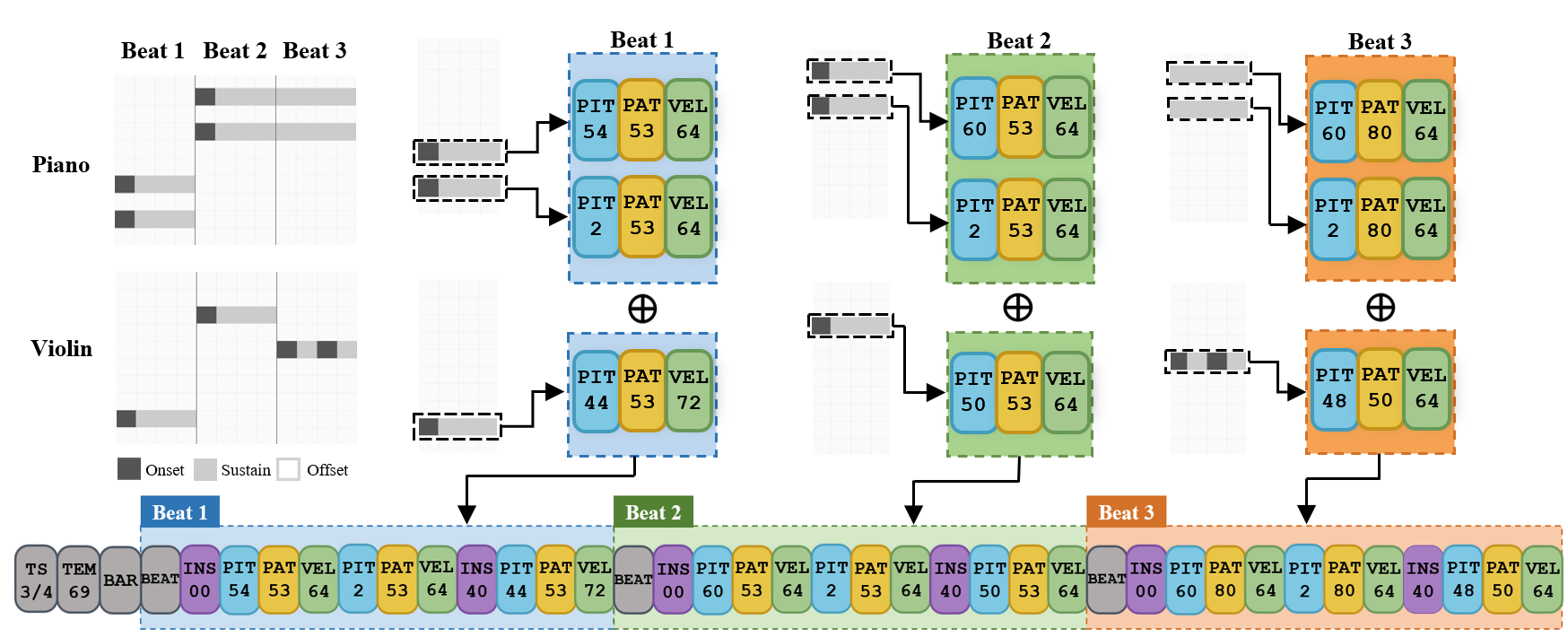
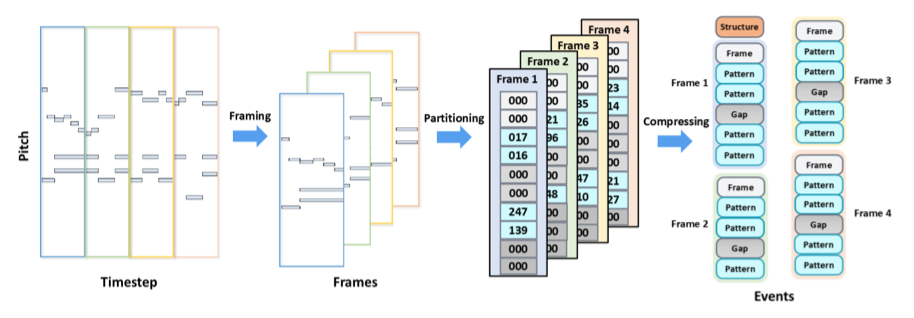
Proposed a novel Pianoroll-Event representation that converts Pianoroll into event sequences for efficient compression while ensuring lossless information. This method significantly reduces sequence length and improves generation quality. Responsible for core encoding design, main paper writing, and critical code implementation.

BEAT Under Review

BEAT: Tokenizing and Generating Symbolic Music by Uniform Temporal Steps

Under Review

Symbolic music generation has advanced rapidly with Transformers, yet a fundamental question persists: what constitutes a good representation? The field has split between event-based and piano-roll representations. We identify the information asymmetry in piano-roll as the key obstacle: information is dense along the temporal axis but sparse along the pitch axis. We propose BEAT (Beat-based Encoding with Anchored Tones), which patches along time and tokenizes along pitch, achieving both structural fidelity and sequence efficiency. BEAT enables autoregressive modeling of piano-roll while preserving its structural advantages, demonstrating state-of-the-art performance and unique capabilities including real-time accompaniment generation.

BeatEdit Under Review

BeatEdit: Symbolic Music Generation as Explicit Editing

Under Review

Proposed BeatEdit, the first framework for symbolic music generation based on explicit edit operations. Traced the absence of edit-based methods in music to the representational level and identified a beat-level structured encoding as uniquely edit-compatible. Three complementary mechanisms span an axis of increasing edit density: per-token sequence tagging for error correction, iterative refinement for accompaniment editing, and tag-then-fill for segment completion. All share a single encoding and pre-trained backbone, outperforming autoregressive and diffusion baselines while remaining efficient with non-autoregressive parallel inference. Cross-encoding analysis reveals notable encoding-method interaction effects on editing effectiveness.

ACG ACL 2026

Anchored Cyclic Generation: A Novel Paradigm for Long-Sequence Symbolic Music Generation

ACL 2026 (Findings)

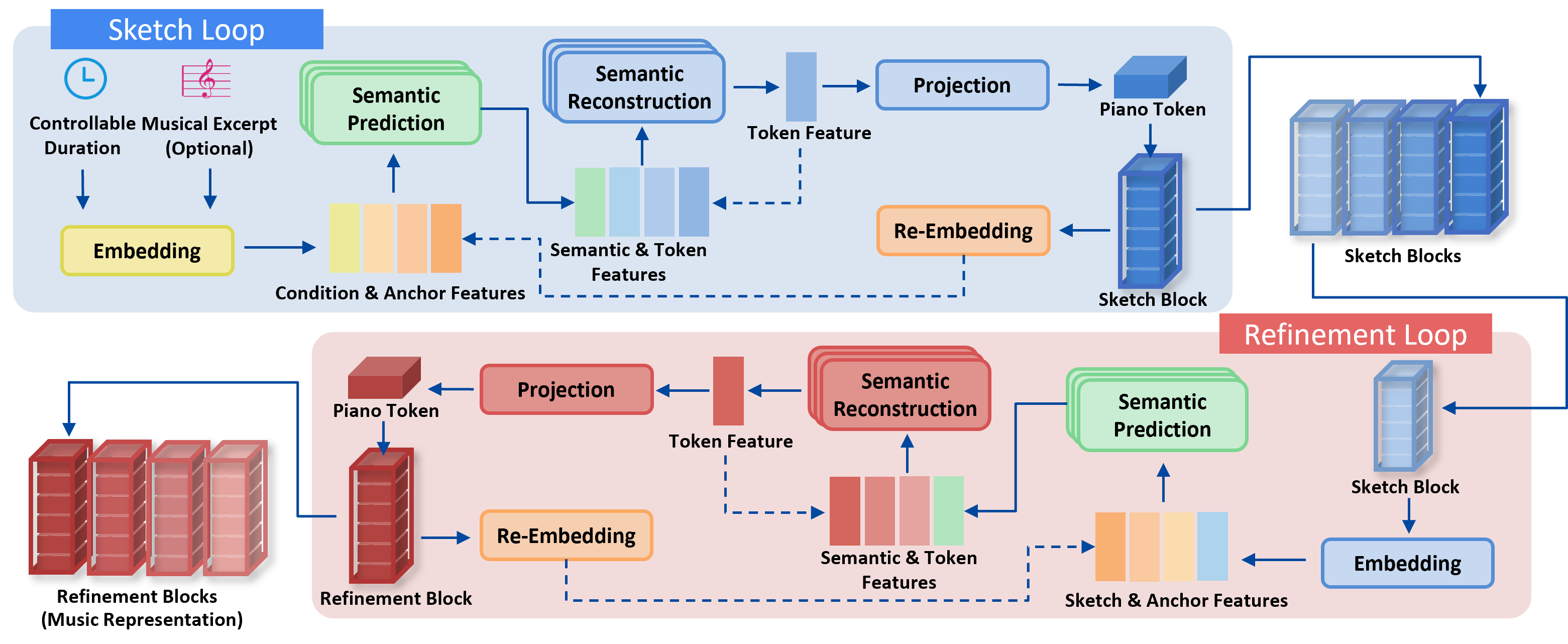
Proposed the Anchored Cyclic Generation (ACG) paradigm that uses anchor features from identified music to guide subsequent generation, effectively mitigating error accumulation in autoregressive models. Introduced the Hierarchical Anchored Cyclic Generation (Hi-ACG) framework with a global-to-local generation strategy and Piano Token representation, achieving superior performance in long-sequence symbolic music generation and demonstrating excellent generalization to music completion tasks.

EmoMM ACL 2026

EmoMM: Benchmarking and Steering MLLM for Multimodal Emotion Recognition under Conflict and Missingness

ACL 2026 (Findings)

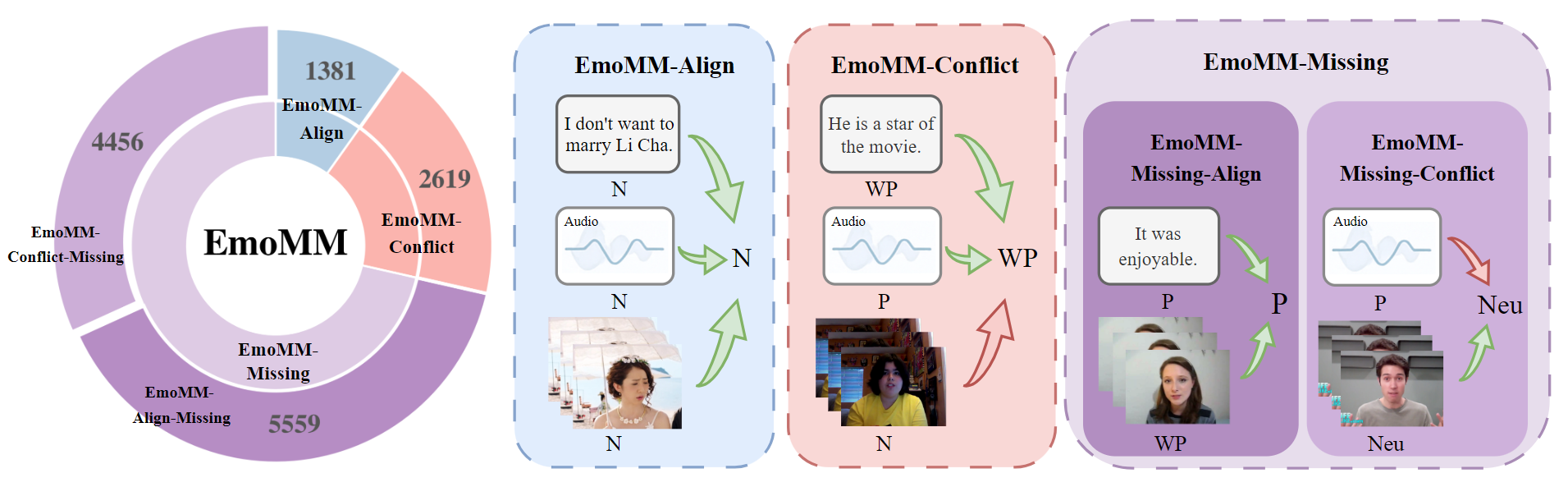
Introduced EmoMM, a comprehensive benchmark for evaluating Multimodal Large Language Models (MLLM) in emotion recognition under modality conflict and missingness. Uncovered the Video Contribution Collapse (VCC) phenomenon and proposed CHASE (Conflict-aware Head-level Attention Steering), a lightweight mechanism that enhances MLLM reliability in complex affective scenarios without retraining.

NeuroCadence Under Review

NeuroCadence: Controllable EEG-to-Music Generation via Continuous Affective Intermediates

Under Review

Proposed NeuroCadence, a modular EEG-to-music generation framework that replaces end-to-end black-box mapping with an explicit valence-arousal intermediate, making brain-conditioned music generation interpretable and diagnosable. Introduced a principled diagnostic protocol that localizes error contributions across stages, providing the first systematic attribution of failure modes in affective brain-to-music systems. Explored continuous numeric conditioning as an alternative to text prompts for fine-grained affective control, offering a generalizable paradigm for any brain-conditioned generation system with independently labelable intermediates.

Under Review

Fractal-BEAT: Beat-Wise Multi-Scale Tokenization for Symbolic Music

Under Review

Proposed FractalBeat, a resolution-invariant multi-scale beat-level tokenization for symbolic music that replaces hand-crafted pattern encodings with a learned codebook, making the vocabulary size independent of temporal resolution. Enables unified tokenization of quantized score MIDI and expressive performance MIDI within a single vocabulary and language model.

Talks & Presentations

Sep. 21, 2025

AI Journey: From Study to Research

🎯 Event AI Association Freshman Seminar
📍 Location SCUT, GZIC, F3-a101

As a member of the AI Association Academic Resources Department, I was invited to share insights on academic studies, competitions, research, and essential computational tools for computer science majors.

Sep. 7, 2025

Academic Planning & Experience Sharing

🎯 Event Jiangsu Students Welcome Meeting
📍 Location SCUT, GZIC, F3-a101

Invited as a student representative to share academic insights and planning strategies with the incoming class of 2025 freshmen.

Sep. 1, 2024

University Life Guide for New Students

🎯 Event Jiangsu Students Welcome Meeting
📍 Location SCUT, GZIC, F3-b101

Invited as a student representative to welcome and guide the class of 2024 freshmen, sharing insights on university academic life and providing practical guidance for their college journey.

My Friends 😊

Mike Meng

Suzhou, Jiangsu

SCUT

Energy Research

mikemengtr.github.io

Walker Sun

Shanghai

SCUT → SJTU

3D Gaussian

zhenyusun-walker.github.io

Kane Wang

Nanjing, Jiangsu

SCUT → NJU

3D Gaussian

sitongwang-nj.github.io

Yeez Zhang

Shenzhen, Guangdong

SCUT

Reinforcement Learning

enzoyeez.github.io

Lekai Qian

Nanjing, Jiangsu

SCUT

Music Generation

marisa-ovo.github.io